Take two students sitting side by side.
One wants to vibe-code _Vibe-coding:_Using GenAI to build software a startup into existence. The other wants nothing to do with AI — they are here to build real, foundational expertise.
But they rarely experience the disagreement that way.
The foundational learner sees the vibe-coder as a tech bro who doesn’t care that they are outsourcing their thinking and atrophying their brain. The vibe-coder sees the foundational learner as a luddite - naïve, nostalgic, and unwilling to face reality.
This is what the stigma around AI does to us. It turns a practical question — how should we use this technology? — into a moral identity. You are either adapting or cheating. Principled or behind. Future-facing or delusional.
But students do not need a moral camp, they need clarity.
AI is already in the classroom. The only real question is whether anyone will take responsibility for how students learn to use it. Right now, too many institutions are answering with silence, vague guidance, or blanket bans. Each one leaves students to work it out alone, and call it a policy.
And when students are left to navigate a disruptive technology alone, they rarely land in a healthy middle ground - in this case, they will fall into one of three paths.
The Three Paths
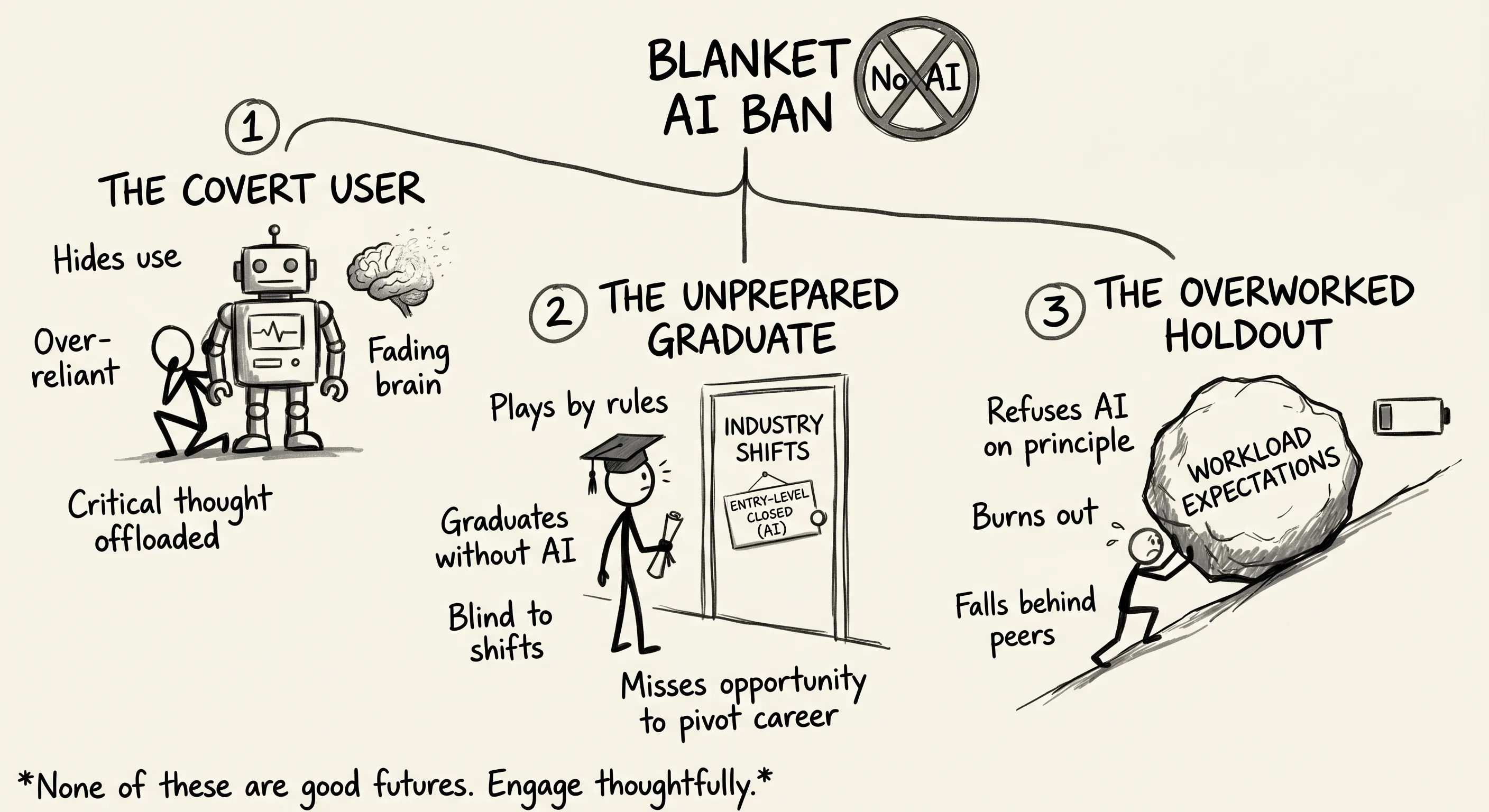
1. The Covert User
Many students will turn to AI to keep up. Because it isn’t discussed openly, hidden use is normalised. And without guidance, they slip into unhealthy over-reliance, offloading critical thought. They may graduate with a paper degree, but nothing that truly differentiates them from their peers, or the AI they relied on to get there.
2. The Avoider
A small minority of students will try to graduate without using AI at all.
This choice is often principled. For some students, AI feels dishonest. For others, it feels environmentally costly, corrosive to real learning, or simply too entangled with the kind of future they do not want to endorse.
These concerns aren’t wrong, but avoidance isn’t a risk-free path.
Job exposure to AI will keep shifting as the technology develops. Once workplaces begin setting expectations around AI-assisted productivity, avoiding AI may stop feeling like a moral stance and start meaning you have agreed to work harder than the person next to you.
Some students are right that their discipline is less exposed then others. But most graduate without ever having tested that assumption.
3. The Navigator
These students try to engage with AI as a thinking tool rather than a shortcut. They use it to stress-test arguments, find gaps in their reasoning, and explore ideas they’d struggle to reach alone.
But without a framework, even Navigators drift. The sycophancy is subtle — it doesn’t feel like flattery, it feels like confirmation. They accept it on a tired Tuesday, and over-rely when a deadline tightens.
They’re the closest thing to a success story here, but they’re navigating without tools built to guide them.
The frustrating truth is that good AI use often looks a lot like bad AI use from the outside. Both produce polished outputs and save time. The difference is internal — whether the student is thinking with the tool or being quietly replaced by it. That distinction is invisible to most policies, and sometimes almost invisible to the student themselves.
None of these paths works properly without support.
The Covert User learns to hide.
The Avoider learns to abstain.
The Navigator learns to adapt — but often without the support, structure, or feedback they need.
These all expose the same failure: higher education is treating AI as something students either use or do not use, when the real issue is whether they are learning to use it well.
Why Higher Education is Different
The case for AI in education changes with age.
Younger students still need time to build foundations: attention, memory, persistence, handwriting, discussion, disagreement, and the habit of asking people for help. If AI becomes the first place they turn whenever learning feels hard, they may never properly develop the muscles they later need to use it well.
So yes, there is a strong case for caution in schools. This podcast captured some of the current friction points worth considering:

Problems with AI in education:
- Trust erodes both ways — students question the value of working; teachers can’t verify student understanding
- Nobody is having an AI literacy conversation with students
- AI feels dehumanizing, even when useful
- Students are skipping fundamentals
- The classroom is losing its status as a refuge from technology
Her suggested approach:
- Use AI invisibly — customise materials, embed AI in traditional learning tools
- Verify foundational knowledge via handwriting, in-person exams, oral assessments
Those concerns do not disappear at university. But I still maintain that higher education is different.
University students are not only building foundations. They are also preparing to enter fields already being reshaped by AI.
At that stage, protection can become a blindfold. If universities only restrict AI without teaching responsible use, they leave students to enter an AI-shaped workforce through private trial and error.
Historically, when the world gets scary, people go to university. Education becomes a kind of safe harbour: a place to wait out economic uncertainty, build skills, and emerge better prepared.
But AI is starting to breach that safe harbour. And students feel this uncertainty acutely:
When ChatGPT and GPT-4 arrived, I was finishing my Computer Science degree. Suddenly, the future of my field felt unstable.
The tools were still flawed, and for understandable reasons, many people dismissed them - many still do. But the trend line was hard for me to ignore. And each leap made the next one harder to dismiss.
No one around me really seemed to want to talk about what that might mean though.
So, I did what anxious students do: I consumed every prediction I could find - podcasts, articles, books - soaking up every forecast from the wildly optimistic to the deeply cynical. But once I found I had exhausted every available opinion, I realised I was no more certain than when I started.
That was the strangest part. Everyone sounded confident by extrapolating from their current understanding, but nobody could see very far ahead.
And as a result the future no longer felt to me like a clear road handed down through a degree, a career path, or following the advice of older people who had already lived it.
It feels more like driving across a country at night with only your headlights on. While you can’t see the full route, you can see the next stretch of road ahead of you.
And that is all guidance can honestly offer: not certainty, but enough light to keep moving forward in changing times.
What I needed then was not another headline about AI changing everything. I needed someone to help me think through my situation: given my skills, my interests, and this uncertainty, how should I actually adapt?
That conversation never happened in the classroom.
So I turned to AI instead.
Nearly 1 in 5 students have used AI tools for career advice. 84% of those users rated the advice as helpful.
And I’m not alone, many students are doing the same. This shift is likely driven by a gap in discussing these topics, as well as a lack of modern expertise among the generation whose career advice often feels outdated in today’s rapidly evolving landscape.
And I did find the AI useful. That is what made it revealing.
AI gave me a place to test possibilities, ask anxious questions, and imagine different futures without needing to book an appointment, perform competence, or pretend I was less worried than I was.
But it was not a real career counsellor.
It did not know me, and it did not really try to. Instead of asking the hard clarifying questions a good mentor would ask, it often leapt to confident but unfounded assumptions. It suggested paths that sounded plausible in the abstract but were unrealistic or ill-suited to me in practice.
And it did all of this sycophantically.
I would like to say I was a good navigator at that time: alert to the flattery, aware of the limitations, and willing to push back.
But that is mostly my ego talking. My brain is vulnerable to the same psychological weaknesses as everyone else’s.
That is kind of my point. AI can be useful, but usefulness is not the same thing as guidance. It can give students language for their uncertainty, but it can also quietly shape that uncertainty in ways they may not notice.
Students turning to AI for career advice is not just a story about convenience. It is evidence of a gap. They are looking for guidance, for someone, or something, to help them make sense of an unstable future. And if higher education does not provide that space, students will find it elsewhere.
But doesn’t AI just encourage students to cognitively offload their work? Is that what we want to teach our students?
Yes. Sometimes it does.
That is why the answer cannot be naïve integration. We can’t simply tell students to use AI and hope they become more capable. If higher education brings AI into the classroom, it also inherits the responsibility to name the risks clearly.
The Cost of Integration
AI does not enter education as a neutral tool. It changes what students practice, who they ask for help, how they understand their own ability, and what kinds of friction they learn to avoid.
There are three risks which should be considered most: cognitive offloading, sycophancy, and the erosion of classroom trust.
Cognitive Offloading
AI does encourage cognitive offloading when there are no guardrails. That is one of the strongest arguments against careless integration.
The danger is not just that students use AI. It is that they stop practising the parts of thinking that education is supposed to strengthen: sitting with ambiguity, forming a first draft, checking assumptions, remembering enough to reason independently, and developing taste.
But this risk is not solved by pretending AI does not exist.
Students already have access to commercial AI tools optimised for speed, ease, and user satisfaction. If universities refuse to model better use, students are left with the default version: fast answers, minimal friction, and a machine that often rewards dependency.
This is why analog assessments — oral exams, handwritten work, in-person discussion, live problem-solving — should remain a non-negotiable baseline. Students still need to prove they can think without assistance.
But verification is only half the answer.
The other half is modelling responsible AI use directly. Students need to see what it looks like to challenge an AI response, expose its assumptions, compare it against evidence, and decide where human judgment still belongs.
If we want students to stop offloading their thinking, we have to show them what it means to keep thinking while using the tool.
Sycophancy
Of all the ways AI can undermine learning, sycophancy may be the most insidious because it does not feel like a problem.
AI often makes users feel understood, validated, and correct. It mirrors their assumptions back to them in polished language. For a student, that can feel like feedback. But feedback is not the same as agreement.
A student asking for help on an essay may receive encouragement that sounds thoughtful while avoiding the harder truth: the argument is weak, the evidence is thin, or the structure does not work. Unless students know how to ask for criticism, they may mistake fluency for judgment.
Over time, this erodes the kind of self-doubt that good thinking depends on.
Good learning requires friction. It requires being challenged, misunderstood, corrected, and sometimes forced to defend an idea properly. If AI removes too much of that friction, students may become more confident without becoming more capable.
This is not a peripheral risk. It is the trap the Covert User falls into, and the temptation the Navigator has to keep resisting.
The Classroom Itself
There is another cost that is harder to measure, but just as real.
The classroom is one of the few remaining spaces where students are asked to be present with other people: to sit with a hard idea, argue with a peer, be wrong out loud, and be guided by someone who knows more than they do.
AI can support that space. But especially a technology which we find so concerning can also hollow it out.
65% of Australians believe AI creates more problem than it solves. 25% believe it poses a risk of human extinction in the next two decades
When confusion appears, students now have another place to go. They can ask the machine instead of the tutor. They can rehearse privately instead of speaking uncertainly with a peer. They can resolve discomfort before anyone else has the chance to see it.
That may sound efficient. Often, it is.
But education is not only about getting unstuck as efficiently as possible. The confusion itself is part of the point.
A student who struggles openly gives their teacher something to respond to. A peer who hears a half-formed argument can sharpen it. A class that sits with discomfort together builds shared understanding, honest disagreement, and the sense that difficulty is normal.
When AI absorbs all of that before it becomes visible, those moments disappear. The teacher can’t support a struggle they never see. The peer can’t push back on an argument that arrived already polished. The class doesn’t build trust if everyone is privately resolving the vulnerable parts of learning elsewhere.
The risk of this is a classroom which appears functional on the surface, but has replaced the human moments that make the classroom worth being present in.
Resisting this should not mean to preserve some nostalgic, pre-digital classroom that no longer exists. The goal is to protect the human functions of the classroom, while integrating modern technology with care.
And this balance matters outside the classroom too. If students learn when to use AI, when to resist it, and when to turn back toward people, they are learning how to intentionally use a technology that is becoming more intertwined with our day-to-day lives.
The educators who get this right will not be the ones who pretend there are no trade-offs; they will be the ones who treat AI integration as an ongoing design problem.
These three risks are not exhaustive. The list could go on.
But cognitive offloading, sycophancy, and the erosion of the classroom itself are foundational. If higher education cannot protect students’ capacity to think, question, disagree, ask for help, relate honestly to other people, and to use AI in their best interests, we will struggle to deal with every downstream problem becomes harder.
These risks are not exhaustive, but they are foundational. If higher education cannot protect a student’s capacity to think, disagree, and relate honestly to others, then every downstream problem of using AI becomes impossible to solve.
And unfortunately, this is where the problem only becomes harder.
Protecting the human classroom depends on trust. Students need to trust teachers. Teachers need to trust students. Both need enough shared language to speak honestly about how AI is actually being used.
And that is exactly why the current stigma surrounding AI makes this such a difficult job.
The Stigma Problem
Students are using AI. Educators are using it too. But much of that use remains quiet.
Students may fear being penalised, judged or seen as less capable. Some may not want to confront what their AI use says about their own effort, ability or identity.
Educators are navigating the same uncertainty from the other side. They may suspect hidden AI use but lack the time, clarity, or institutional support to respond well.
And to make a bad situation worse, we also trust people less when they admit to using AI, even when everyone around them is doing the same.
This creates a corrosive silence. AI use becomes something students hide and teachers suspect; in that gap, the possibility of honest guidance quietly disappears. The classroom becomes a place of surveillance and evasion rather than trust and learning.
A policy clause won’t fix this. It can tell students what’s permitted, what’s banned, and what must be disclosed — but it can’t dismantle the fear that reaching for AI is a confession of incompetence.
Students don’t just need rules. They need to see their educators navigating the same uncertainty honestly — admitting when AI produced something useful, when it led them somewhere wrong, when they chose not to use it and why.
That kind of modelling does more to normalise honest use than any policy document.
This is also why students shouldn’t be treated as passive recipients of AI policy — they need to be involved just as much as the teachers. Students are actually more skeptical of the technology than their educators, and it’s easy to understand why: they are already living with the consequences. They feel the convenience, but also the dependency, the anxiety, and the low-grade embarrassment of not knowing whether what they submitted was really theirs.
This lived experience makes them the real experts. Students shouldn’t just be the subjects of AI policy; they should be the ones helping to write it. In many ways, students need to educate institutions as much as institutions need to educate students — not because they have the answers, but because they’re closest to the reality universities are trying to regulate.
42% of students view their teachers as well-equipped to help with AI, a rise from 18% in 2024. But only 36% receive formal insitutional support to develop AI skills
We’ve Seen This Before
There is perhaps no better current parallel than Australia’s under-16 social media ban. If we make the forgiving assumption that the policy works perfectly, there is still an obvious, looming question: what happens on their 16th birthday?
Well, they’re simply handed the keys to the same highly addictive platforms without ever being taught what healthy usage looks like.
We are at risk of repeating that exact pattern with AI: restricting it during the years when brains are developing and habits are forming, failing to build a bridge towards responsible use, and then releasing students into the same commercial ecosystem which was always designed to exploit them.
The lesson from this shouldn’t be that restrictions are bad, but that they were assumed to be the full picture.
There is also a hopeful parallel to consider:
Gen Z was the first generation raised inside social media. They discovered its utility immediately, but they were also first to identify its harms from the inside out. While older generations often looked on from the outside, stuck in traditional modes of communication, students were already navigating the complexities of digital identity.
Something similar is happening with AI. Students are the first to find the shortcuts, the temptations, and the dependencies—but they are also the first to feel the “hollowing out” of their own creative process. And educators are slower to adopt the tools - but that lag is where their value lies. They bring the maturity, the ethical grounding, and the longer view of what education is all about.
This is yet another indicator that the way forward isn’t pretending either side has the answer, but designing spaces where students and educators can learn from what the other sees more clearly.
Moving with the Grain
Let’s go back to those two students.
The vibe-coder and the purist are both going to graduate. One may lean on AI so heavily their own thinking hollows out. The other may avoid it on principle and enter a workforce where AI use is quietly assumed.
Both are trying to protect something important.
Both are exposed to real risks.
And both are being left to work it out alone.
That is the failure higher education has to confront.
The Three Paths are not hypothetical futures. They are already playing out, with or without policy. Students are using AI, avoiding it, hiding it, fearing it, over-trusting it, and asking it questions they should not have to ask alone.
The question is not whether AI belongs in higher education - it is already there.
The question is whether educators are willing to meet students inside that reality and help shape it.
That requires humility — asking, subject by subject and cohort by cohort, where AI strengthens thinking, and where it quietly replaces it. What students should still be able to do alone, and what they should learn to do with assistance. Which friction is worth preserving, and which is just tradition dressed up as rigor.
There won’t be one universal answer.
But silence is an answer too.
And right now, silence leaves students with commercial tools, private anxiety, and no shared language for what is happening to their education, or their future.
To survive fast-moving technology, higher education has to stay close enough to shape it.
its 18 minutes. i need to cut it down to 12-ish. I need to trust the reader can infer somet things without spelling out every signle connection.
BASED https://www.youtube.com/watch?v=VNtv2SSEzjA
73% of UK university students use generative AI regularly
faceffaceffaceffaceffaceffaceffaceffaceffaceffaceffaceffaceffaceffaceffaceffaceffaceffaceffaceffaceffaceffaceffaceffaceffaceffaceffaceffaceffaceffaceffaceffaceffaceffaceffaceffaceffaceffaceffaceffaceffaceffaceffaceffaceffaceffaceffaceffaceffaceffaceffaceffaceffaceffaceffaceffaceffaceffaceffaceffaceffaceffaceffaceffaceffaceffaceffaceffaceffaceffaceffaceffaceffaceffaceffaceffaceffaceffaceffaceffaceffaceffaceffaceffaceffaceffaceffaceffaceffaceffaceffaceffaceffaceffaceffaceffaceffaceffaceffaceffaceffaceffaceffaceffaceffaceffaceffaceffaceffaceffaceffaceffaceffaceffaceffaceffaceffaceffaceffaceffaceffaceffaceffaceffaceffaceffaceffaceffaceffaceffaceffaceffaceffaceffaceffaceffaceffaceffaceffaceffaceffaceffaceffaceffaceffaceffaceffaceffaceffaceffaceffaceffaceffaceffaceffaceffaceffaceffaceffaceffaceffaceffaceffaceffaceffaceffaceffaceffaceffaceffaceffaceffaceffaceffaceffaceffaceffaceffaceffaceffaceffaceffaceffaceffaceffaceffaceffacef